




Will XREAL Glasses Be Comfortable Long Term? Check IPD, Pressure and Readability
Published specifications cannot tell you that XREAL has a high or low buyer-remorse rate, or predict whether your eyes and nose will remain comfortable. Choose by optical fit, prescription and a representative seated trial. One Pro’s explicit M/L IPD options make an important fit check possible, but are not a guarantee of symptom-free wear.
There is no supported universal comfort ranking here
The question asks whether IPD and eye fatigue cause high buyer remorse. The sources used here do not provide a representative buyer-remorse survey or a controlled cross-brand symptom study. A complaint can reveal a useful issue to test; it does not establish how often all owners experience it. Treat manufacturer comfort descriptions and personal reports as different forms of evidence.
Three separate things can make the same frame feel wrong
| What you notice | Purchase check | What the number cannot prove |
|---|---|---|
| Image centre clear, edges difficult | Confirm size, prescription and frame position | A wider field of view does not guarantee readable edges |
| Nose-bridge pressure | Compare the supplied nose-pad fit and weight distribution | Lower total mass does not measure local pressure |
| Fatigue during movement or text | Try a readable scale and supported positioning mode | Higher refresh rate does not guarantee comfort |
One Pro’s published size intervals are M 57–66mm and L 66–75mm. Choose using a reliable measurement and a fit check rather than treating the shared boundary as a diagnosis. A legacy Air 2 Pro specification describes a different frame and should not be used to predict One Pro’s balance.
Test a realistic session, including prescription inserts
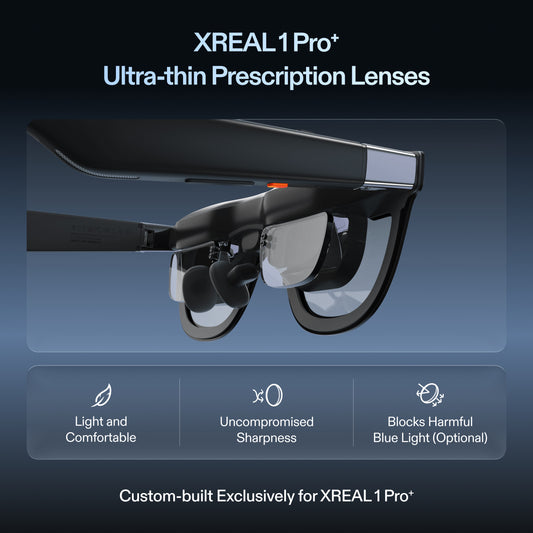
Begin with a short seated use and evaluate one ordinary activity, such as reading subtitles or editing a document, before trying a longer session with breaks. Check the nose and temples as well as the image. Prescription inserts may alter clearance and perceived balance; compare the finished optical setup rather than an empty demonstration frame. Stop the trial if discomfort occurs rather than attempting to prove that you can adapt to it.
For lying-down films, include the pillow and usual head position. For flights, include the seat posture and controls. A supplier’s display-stability feature is not evidence that one model causes less nausea than every competitor.
Be cautious about aftermarket fixes and all-day promises
An aftermarket nose pad can change the contact point; it cannot be assumed to solve an optical mismatch or a wrong prescription. Check compatibility and warranty implications before modifications. Persistent symptoms warrant professional advice rather than relying on an article to diagnose their cause.
The UK return policy excludes customised products. Its opening paragraph measures 30 days from ordering, while later conditions refer to receipt. Ask the seller to confirm the applicable deadline and lens terms in writing before relying on a trial. Keep packaging and seek return authorisation first. The policy text is especially relevant if you need custom lenses before you can make a meaningful fit assessment.
When XREAL is worth shortlisting
One Pro is relevant if its documented IPD option, positioning and compatible insert route meet your requirements. A physical display avoids wearing optics altogether; a different frame may distribute pressure differently. Those are practical alternatives, not evidence that any one brand universally prevents eyestrain. Record which task and fit configuration passed before choosing.
Add a first-hand observation without turning it into a comfort statistic
Tom’s Guide’s One Pro review describes a favourable wearing experience over a long flight. That is useful first-hand context alongside the measured IPD size and a personal trial. It does not establish clinical eye-strain prevention, pressure measurements or the proportion of owners who feel the same way.
IPD fit and head width answer different questions
One Pro's M range of 57–66mm and L range of 66–75mm describe optical IPD fit. They are not head-circumference ranges, temple-width measurements or a promise that one frame fits every nose. At the shared 66mm boundary, compare the actual fitting with the seller instead of treating a single PD number as a complete sizing verdict.
Check three contact areas with your normal posture: the nose support, both temple sides and the point where the arms meet a pillow or headrest. Use the supplied S/M/L nose-pad options where appropriate to the instructions. Recheck both image edges after each adjustment; moving the frame to relieve pressure can also move your eyes relative to the optics. A prescription trial should include the completed insert.
| Result of your fit check | What it means for the purchase |
|---|---|
| Readable centre and edges; no distracting contact in the intended task | Continue evaluating a representative session with breaks |
| Pressure improves but the image becomes clipped | The adjustment has not yet solved both mechanical and optical fit |
| Correct IPD band but the temples press against your head | The IPD number alone is insufficient; seek a fitting comparison |
| A pad change leaves persistent blur or symptoms | Reconsider the configuration and ask for qualified fitting advice |
These are assessment criteria, not laboratory measurements or a medical screening tool. They explain why a lighter rival or higher refresh rate alone cannot settle long-term comfort.
Product reference: match the exact generation
XREAL One Pro

Image: XREAL.
| Parameter | Manufacturer detail |
|---|---|
| Display | 1920 × 1080 pixels per eye; up to 120Hz |
| Field of view / mass | 57° / 87g excluding cable |
| Positioning | X1 chip; native 3DoF Anchor |
| Optical sizes | M: IPD 57–66mm; L: IPD 66–75mm |
| Source | Compatible DisplayPort video over USB-C; source runs content |
Manufacturer product information.
XREAL Air 2 Pro (legacy reference)

Image: XREAL.
| Parameter | Manufacturer detail |
|---|---|
| Generation | Air 2 family; not One Pro |
| Display | 1920 × 1080 pixels per eye |
| Field of view / mass | 46° / approximately 75g excluding cable |
| Dimming | Electrochromic lenses |
| Screen positioning | Depends on the supported source/accessory/software path |
Manufacturer product information.
Manufacturer specifications describe capability, not independent comfort, reliability or support rankings. Values were checked on 29 October 2026; confirm the selected model and live availability before ordering.
FAQ
Does a matching IPD guarantee a comfortable full day?
No. Prescription, frame position, nose contact, task and session length still matter.
Do long-term reviews prove that buyer remorse is high?
Individual reviews can identify issues, but the sources here do not establish a representative remorse rate.
Are inserts necessarily too front-heavy for films?
The effect depends on the finished lenses and fitting. Trial the prescription-ready configuration rather than assuming either outcome.
Your next step
Check UK optical sizes and arrange a realistic fit assessment
Sources
- XREAL documentation or UK shop policy
- XREAL documentation or UK shop policy
- XREAL documentation or UK shop policy
- XREAL documentation or UK shop policy
Prepared for XREAL UK. Manufacturer specifications and purchase-check guidance; no independent laboratory test or representative owner survey is claimed. Source check: 29 October 2026.